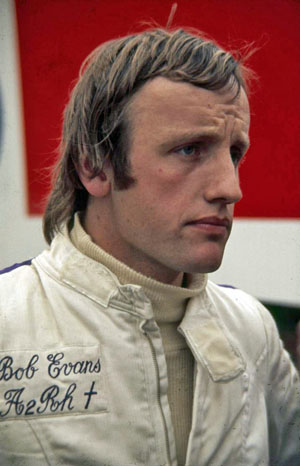
Name:Bob   Surname:Evans
Country:United Kingdom   Entries:12
Starts:12   Podiums:0
Fastest laps:0   Points:0
Start year:1975   End year:1976
Active years:2    

Robert “Bob” Evans (born 11 June 1947 in Waddington, Lincolnshire) is a British former racing driver from England.
He participated in 12 World Championship Formula One Grands Prix, debuting on 1 March 1975. He scored no championship points. He also competed in numerous non-Championship Formula One races. Info from Wiki


Bio ny Stephen Latham

Born on the 11th June, 1947, in Waddington, Lincolnshire, Robert Neville Anthony Evans competed in 12 World Championship Grands Prix plus drove in numerous non-championship F1 races. After a season with BRM in 1975, he tested for Lotus in the following year plus entered two races with them and drove a RAM Racing Brabham in that year’s British Grand Prix.

He started racing an Austin Healey Sprint before switching to Formula Ford in 1969 and was a race winner in his second season. From there he graduated to Formula 3 in 1971, driving Alan McKechnie’s alloy and balsa wood Puma. The car was designed in 1969 by Tony Hilder (who had worked on the McLaren M1A sports car) and the Puma’s monocoque was unusual as it was made of Mallite, an aluminium/balsa wood sandwich that was also used in the 1966 McLaren M2B. The Puma was hidden away in a Peckham lock-up for two years as McKechnie ran a F5000 team and was discovered and driven by Bob. The car showed promise, with a pole position first time out, and though it was initially hampered by poor BRM engines, a change to a Vegantune unit greatly improved things. His best results came in June, when he was third (behind James Hunt and Roger Williamson) in the Chris Moore Memorial Trophy at Crystal Palace and at the end of the month he took victory in the Kentish Times Trophy at Brands Hatch. Unfortunately, he sustained a neck injury in a serious accident during a mid-summer test at Castle Combe though once recovered he returned to racing and in late December won the Christmas Championship Trophy at Brands Hatch with McKechnie’s ex-James Hunt March 713M. In further drives with the March at this meeting, he was fourth in a Yellow Pages Trophy race that afternoon and fifth in a race the following day. The Puma was revised in 1977 as the 377 and entered for two races to give Nigel Mansell his start in F3, at Donington and Silverstone.

Bob started over 40 races with the March during 1972 though later in the season switched to a March 723. In the first four races he was seventh and third at Brands Hatch plus fifth at Mallory Park and Oulton Park. Further results included fifth at Silverstone, third at Zandvoort, second at Silverstone, sixth at Crystal Palace, Oulton Park and Cadwell Park and he took victory in May at Brands Hatch. He contested three French rounds with a 723, with his best result sixth at Chimay, and from August raced it in the British series, where he was third at Brands Hatch, second at Silverstone plus sixth at Crystal Palace, Oulton Park, Brands Hatch and Thruxton.

He and McKechnie moved up to F5000 in 1973 with a Trojan T101-Chevrolet and took victory in October at Snetterton, eventually finishing ninth in the Championship. He also entered the F3 race at Monaco with the March 733 but did not qualify. He continued in F5000 the following year plus had a sportscar outing alongside Richard Lloyd in a March 74S at the 1000 km Brands Hatch and they finished eighth. Racing McKechnie’s Lola T332-Chevrolet, with Henley Forklift backing, he was up against an F5000 field that included Teddy Pilette, Lella Lombardi, David Hobbs, Vern Schuppan, Tom Belso, Brian Redman, Chris Craft, Mike Wilds, Damien Magee, Guy Edwards, Roelof Wunderink, Derek Bell, Eddie Keizan and Tony Trimmer. In early races he was eighth and sixth at Silverstone and Oulton Park, which were both won by Brian Redman but he beat him to take his first victory, at Brands Hatch in April. Although David Hobbs and Brian Redman won some early races, they missed a number of rounds in order to compete in the American series. He was second to Gethin at Zolder and Zandvoort, third to Ashley and Gethin at Thruxton plus second to Hobbs at Mugello. After finishing third at Monza (to Gethin and Teddy Pilette) in July, he took victory ahead of Gethin at Mallory Park and went on to take the following races at Mondello Park and Thruxton. Following these victories he was third at Brands Hatch though only sixth and fifth at Oulton Park and Mallory Park. The next four races were won by Vern Schuppan, Tony Dean, Ian Ashley and Tom Belso, then Guy Edwards returned from injury to win the penultimate race and Vern Schuppan took the final round. Bob took the Rothmans Championship with 193 points, ahead of Gethin and Ashley on 186 and 152 and at the end of the year also received the prestigious Grovewood Award.

Although he continued in F5000 in 1975, he received an offer to drive BRM’s P201 and started the year in F1. The P201 was designed by Mike Pilbeam and raced in the 1974 and 1975 F1 seasons (and in P201B specification in 1976 and 1977). Their drivers for 1974 had been Jean Pierre Beltoise and Henri Pescarolo but at the end of the season Beltoise retired from F1 and Pescarolo left the team. P201s participated in eleven of the fifteen races in 1975 but, having lost their Motul backing, Louis Stanley was only running a single unsponsored car, which was well past its best. Mike Wilds competed in the first two races at Argentina and Brazil but retired from both, due to engine failure and a broken flywheel. Bob was in the car for South Africa and to his credit, qualified eight times out of the nine races entered. He started twenty fourth at Kyalami and finished fifteenth though in Spain he retired after seven laps with fuel system problems and did not qualify at Monaco. He achieved his best GP result when he came home ninth in Belgium and was thirteenth in Sweden but retired after twenty three laps with transmission problems in the Dutch GP. He was seventeenth in France but the team did not appear at the British or German Grands Prix and retired in his final two races, with engine problems in Austria and electrical problems at Monza. In non championship events he finished sixth in the Race of Champions at Brands Hatch in March and in the following month was tenth in the International Trophy at Silverstone. Contesting F5000, his first races came in July and August, in two rounds with Theodore Racing Team’s Lola T332, where he won at Snetterton though retired due to an accident at Mallory Park. In the following month he was fourth with Reed Racing’s T332 at Silverstone and in two late races in October was fourth at Mallory Park with a privately entered Lola T400 and third with Alan McKechnie’s T400 at Brands Hatch.

He was offered a testing contract with Lotus for 1976 but unfortunately, the team were in decline and initial tests of their Lotus 77 were disappointing. Ronnie Peterson quit after the first race and Bob took over the car for the South African GP, racing alongside Gunnar Nilsson, and finished tenth. There were two more races that month and he ran as high as fourth in the non championship Race of Champions before running out of fuel then failed to qualify in Long Beach and after just three races he was replaced by Nilsson. Mario Andretti joined the team in time for the Spanish GP and eventually, the car improved dramatically. At the final race of the season in Japan, held in soaking wet conditions, Andretti took pole position and while all the attention was on James Hunt’s drive, he took a morale-boosting win for Lotus. After his short stint with Lotus, there was another GP outing for Bob in July, when he drove RAM Racing’s Brabham BT44B in the British Grand Prix, though gearbox issues ended his race after twenty four laps. In June and October he contested two 250 km Fuji races with an Alpine A441, finishing third and sixth and there were also two European F5000 Championship drives with Hepworth Racing’s McLaren M25 where he was second (to David Purley) at Brands Hatch but retired at Thruxton.

His first drive in 1977 came in the International Trophy European F2 race at Silverstone with Tom Wheatcroft’s Hart powered Pilbeam R27 but he did not finish plus retired from the BARC 200 at Thruxton due to a puncture. In between these two drives he entered the non championship Race of Champions with Hexagon Racing’s Penske PC3 and finished eleventh but though entered for a European F5000 round at Brands Hatch with a Chevron B30 he was unable to start due to mechanical issues. There followed a switch to the Aurora British F1 Championship in 1978, which replaced the Shellsport Group 8 series. As part of the changes, F5000 and Formula Atlantic cars were no longer eligible to race in the championship, while F1 cars were now the focus of the series, with F2 cars still being permitted as a ‘B-class’. He started the series with a Surtees TS19 and won at Zandvoort (beating Divina Galica and Boy Hayje) and was third at Donington Park. After switching to a Hesketh 308E results included second at Thruxton (twice) and Brands Hatch, fifth at Oulton Park plus seventh at Mallory Park and Snetterton and he finished second in the standings behind the dominant Tony Trimmer. The year also saw a Le Mans debut when he teamed with Richard Down to race Cloud Engineering’s Lola T294S but, after an accident in practice, they raced the T-car though retired after twenty three laps.

There were no more single seater outings after this and from 1979 he raced for Dome in five consecutive Le Mans 24 Hour races. Dome had first appeared in Europe at 1978’s Geneva Motor Show with a road prototype and a racing version of the Dome Zero was entered for Le Mans. The distinctive wedge-shaped design came from Masao Ono, who had worked on the Maki F1 project and was developed in England by a team led by former De Cadenet team manager Keith Greene. Two cars were built, with the original tested at Fuji Speedway then debuted at a World Championship round at Silverstone, driven by Chris Craft and Gordon Spice, and they were joined at Le Mans by Bob and Tony Trimmer. During the first qualifying runs, the cars ran well but encountered electrical problems so all the electrical wiring was changed during the night. At the end of the first qualification, they were eighteenth while the Craft/Spice car was fifteenth and clocked at 340km/h, close to the Ford M10. However, heavy rain the following day meant that fast times could not be attempted. Craft and Trimmer were the drivers designated to start the race and after the first lap, Craft was twelfth and Trimmer nineteenth. However, on the second lap lap, Craft had stopped at Arnage with a blocked accelerator and had suffered a small fire but though he was able to reach the pits they had lost three laps. He was able to rejoin the race again but was now running in forty ninth position. During this time, Trimmer had reached fifth place after an hour into the race but, from the second hour onwards, the engine began overheating and after three hours they suffered a head-gasket failure. The Craft car had climbed to twenty first but again began suffering problems with the accelerator and eventually stopped after five hours with fuel supply problems. The team were back the following year with a single entry, for Bob and Chris Craft, who had conducted an 18-hour trouble free test in Japan. Their new RL80 still had the distinctive low, wedge-shaped design but was now shorter and wider while its improved suspension and aerodynamics made it one of the fastest Group 6 cars, getting up to 345 kp/h (215 mph). On the Wednesday a tyre came off while Craft was at full speed approaching Mulsanne and it happened again while running in the rain on Thursday so the crew glued the tyres to the rims and they qualified eighth. However, in the race a forced pit stop lost them over four hours and when they rejoined they ran at the back of the field. They eventually finished twenty fifth, with 246 laps completed, and the last of the runners. The Zero RL returned to Le Mans with a new chassis in 1981, again with the pairing of Bob and Craft, with the car painted blue with yellow striping. They qualified twentieth though had climbed up to eighth at the two hour mark and despite electrical and ignition problems, they ran for 15 hours before having to retire due to engine problems.

He had two races in 1982 with Nimrod Racing Automobiles, which had been formed in 1981 by Robin Hamilton and Aston Martin chairman Victor Gauntlett to build a Group C competitor based on an Aston Martin engine. They used the T385 design from Eric Broadley at Lola and built it on an aluminium hull. Utilising a fuel-injected Aston Martin 5.3-litre V8, which was tuned by Tickford Engineering, it put out 570 bhp and could get up to 320 kp/h (200 mph) but at 1050 kg, it was the heaviest of the Group C cars. Two chassis were built and one sold to Viscount Downe (an Aston Martin shareholder) and raced by Ray Mallock, Mike Salmon and Simon Phillips while the works car had Geoff Lees, Tiff Needell and Bob. Unfortunately their Le Mans race ended after fifty five laps due to an accident while he and Geoff Lees retired after 148 laps from the 6 Hour Silverstone due to mechanical issues.
In a further Nimrod outing two years later, he was teamed with John Cooper and Paul Smith in the 24 Hour Daytona and the trio finished seventh. His only other drive that year came in May alongside Frank Jelinski with a Gebhardt JC842 at the 6 Hour Silverstone but they retired due to engine issues. He was back in 1985’s 6 Hour Silverstone, this time with Tiff Needell and Steve O’Rourke in an EMKA C84/1, but they did not finish. There was a fifth place result in a Thundersports round at Brands Hatch with Sean Walker in a BMW powered TOJ SC205 while in two further Thundersports drives in 1986, teamed with Divina Galica, they were ninth at Brands Hatch but did not start at Birmingham.
Bob retired from the sport and later ran a catering business and then a shirt-printing firm, which became a motor racing team clothing and racewear business. Following this he ran a digital printing business, including posters, which he later sold.


Bob Evans was a fairly talented British driver who reached F1 by making his name in F5000. These were the glory days of F5000, the F1-style open-wheel category running championships on both sides of the Atlantic. In 1973, Evans had already been a factor, driving an Alan McKechnie-run Lola T101 before taking the Rothmans European F5000 Championship in 1974. It was a T332 that gave Evans the breakthrough he desperately needed, having survived an F3 testing accident at Castle Combe just three years before.

The coveted F5000 title made Louis Stanley notice Bob. It secured the young Brit an F1 drive at BRM for 1975 – but with the lingering team losing its Motul backing it had to revert to entering a single sponsorless P201, an outdated Mike Pilbeam design Beltoise had not been able to get the work the year before – except for its debut race, scoring an unexpected second. Here, at the Dutch GP at Zandvoort, one and a half year later, Bob merely equalled his best qualifying position, a poor 20th he also managed at Zolder and was to repeat in his BRM farewell GP at Monza.
It all seemed over had it not been for Colin Chapman’s soft spot for hard-working British blokes giving Evans a reprieve. Bob was signed on as a test driver, but with the 76 and its successor, the 77, so far proving hopeless, Evans had joined the legendary team at precisely the wrong time. Lotus was in the doldrums, Ickx having left in disappointment and Peterson and Andretti following suit after a disastrous Brazilian GP. Paired with young gun Gunnar Nilsson, Evans was thus given the opportunity to move to the race team. This time, however, he failed to impress, Andretti returning after just two races for Parnelli Jones, turning the difficult 77 into a winner by the end of the season. At the Race of Champions Evans also drove and was unlucky to lose fourth place after running out of fuel. A one-off at the British GP in one of RAM Racing’s Brabhams was the last we saw of Bob Evans, in World Championship terms that is. The Englishman returned to an F1 cockpit on several more occasions. In 1977, he was picked to drive the Goldie Hexagon Penske in the Race of Champions, while in 1978 he contested the inaugural Aurora AFX championship in a Surtees.

Evans’ departure from F1 coincided with the sorry demise of his former employer, BRM leaving F1 through the backdoor after its Rotary-backed P207 proved a complete failure at the hands of Teddy Pilette, the third and least talented generation of a famous Belgian racing dynasty. The embarrassing 1977 string of non-qualifications was in sharp contrast to the dominance BRM had shown in the early sixties, while remaining a race-winning outfit into the seventies. After Alfred Owen had sold out to sister Jean and brother-in-law Louis Stanley the team didn’t seem on a decline at first, the BRM name still able to attract top drivers like Rodriguez, Siffert, Regazzoni or Beltoise. What must have been to his regret, the signing of rookie Bob Evans was the first clear evidence of BRM’s imminent downfall.



1975 GP Dutch. Photo Walter C Harbers III

Gallery   F1   Le Mans   F5000   F3


Other bios and info

error: Content is protected !!

This website uses cookies to give you the best experience. Agree by clicking the 'Accept' button.