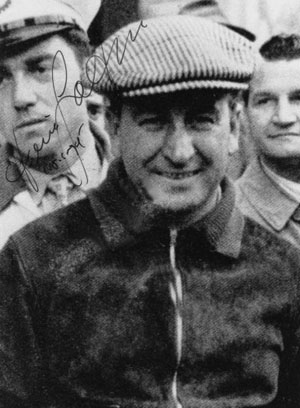
Name:Dorino   Surname:Serafini
Country:Italy   Entries:1
Starts:1   Podiums:1
Fastest laps:0   Points:3
Start year:1950   End year:1950
Active years:1    

Teodoro “Dorino” Serafini (22 July 1909 – 5 July 2000) was a motorcycle road racer and racing driver from Italy.

A native of Pesaro (Marche), he won the 1939 500cc European Championship on a Gilera. He participated in one Formula One World Championship Grand Prix on 3 September 1950, when he finished second and scored 3 championship points, his points being halved as he shared the drive with Alberto Ascari. Serafini still holds the record for highest percentage of podium places per race, 1 podium in 1 race gives him a 100% score. He also competed in several non-Championship Formula One races. Info from Wiki


Bio by Stephen Latham

Hailing from Pesaro, Italy, Teodoro ‘Dorino’ Serafini starting competing on bikes and went on to become a successful motorcycle racer during the 1930s and in 1939 won the 500cc European Championship. He later contested several non-championship F1 races, finishing second in several of those entered, and one world championship GP, the 1950 Italian, in which he shared the second placed Ferrari with Alberto Ascari.

Born on the 22nd July, 1909, he was the oldest of four sons of a carriage builder and beekeeper and his father’s passion for motorcycles rubbed off on young Dorino. Also, the Benellis (five brothers, Tonino, Francesco, Giuseppe, Filippo and Mimo) were based in Pesaro and they were building potent 175cc bikes, and when Dorino started racing in 1928, on a Benelli 175, he set the fastest time on his debut at the Circuit of Rimini. He raced for Benelli for four years then switched to MM (Morini and Massetti) and became Italian National Champion in the 175cc category in 1933, racing in a white sweater with the company’s initials embroidered on its chest. After moving up to the 500cc class on a Bianchi in 1935 he won the prestigious ‘Circuito del Lario’ race, then in 1936 won the Coppa Acerbo at Pescara and took the Italian Championship plus won at the Circuito del Giardini Margherita in Bologna in 1937. Now very much in demand, both Guzzi and Gilera were keen to sign him, after choosing Gilera he had a second Lario race win in 1938 on a Gilera 500 then in 1939 was the 500cc European Champion, with victories in the German, Swedish and Ulster Grands Prix. During this period he also contested several Gran Fondo Milano-Taranto, a 1300 kilometre (808-mile) road race along the Italian peninsula from Milan to Taranto but despite dominating them, he retired due to accidents or mechanical failure while leading. His best result was third place in 1937 on a Bianchi 500 and then he set a record time in 1940 with a Gilera 500, riding in pouring rain in the Milano-Bologna stage at a speed of 172.300 km/h (107 mph).

After the War, Dorino switched to 4 wheels, first in sports cars but then in March 1947 he finished seventh with a Cisitalia D46 in the Sehab Almaz Bey Trophy held at El Gezirah circuit in Cairo, Egypt. In further outings with the D46 he contested the Coupe de Petites Cylindrées at Reims-Gueux road course plus the Grand Prix de Albi though retired from both. There was also a drive at a Caracalla street circuit plus he contested his first Mille Miglia, alongside Dante Cappelletto, in a BMW 328 but they did not finish. In August he raced a Scuderia Milan Maserati 4CL in the XIII Grand Prix de Comminges at St Gaudens, where he led the race from the start, setting the fastest lap in the opening stages. However, the steering column suddenly failed and he crashed heavily, breaking his ribs, arms and legs as well as suffering burns.

After a long convalescence, he returned to racing and in 1948 finished thirteenth in a privately entered Healey 2400 Elliott with Giovanni Lurani in the Targa Florio plus racing a Healey 2000 with Count Johnny Lurani they took second place in the Tour of Sicily.
He won the Circuito del Garda sportscar race at the wheel of a factory Osca MT4 1100 plus raced a Maserati A6GCS at the Circuito di Firenze but did not qualify a Scuderia Milano Maserati 4CL for the Gran Premio de´ll Autodromo di Monza.

In 1949 he drove a Scuderia Ambrosiana entered Frazer Nash (with Rodolfo Haller as co-driver) in the Giro di Sicilia. However, after leading the 1,080 kilometres (671 miles) race for more than half distance, he skidded into a kerb and crashed and his race was over. The pair also competed in the Mille Miglia with a Frazer Nash High Speed but did not finish. In a number of outings in OSCAs he retired an MT4 from the Coppa della Toscana and the Gran Premio Automovilista de Madrid, was fourth at Pescara in an MT4 1350 though retired it at the Prix de Léman at Circuit de Lausanne while teamed with Alberico Cacciari they won the Giro delle Calabria (held on a Catanzaro road course) with an MT4 1100. At the end of the year he was offered a drive by Ferrari alongside Ascari and Villoresi and he travelled to Argentina for the Temporada series and finished eighth in December’s Gran Premio del General Juan Perón at the Palermo Park circuit in Buenos Aires with a Ferrari 125C.

The series continued into 1950 and in three races in January with the 125C he was second (to Luigi Villoresi and ahead of Clemar Bucci and Juan Manuel Fangio) in the Gran Premio Maria Eva Duarte Peron at Palermo Park but did not finish in the Gran Premio del General San Martín at the Circuito El Torreón and the Copa Acción de San Lorenzo at Circuito Parque de la Independencia. On his return to Italy, he and the other Italian drivers who had made the trip, among them Ascari, Farina, Villoresi and Taruffi, were received by Pope Pius XII in a special audience. Continuing with the Ferrari back in Europe his first race came in April in the Gran Premio di San Remo at the Circuito di Ospedaletti but he did not finish. A week later he and Ettore Salani finished second in the Mille Miglia in a Ferrari 195S Barchetta Touring, behind Giannino Marzotto-Marco Crosara in a Ferrari 195 S Coupé Touring though ahead of Juan Manuel Fangio’s Alfa Romeo 6C 2500 Competizione Berlinetta. During the Mille Miglia, it rained for virtually the whole race and Dorino was soaked in the open Ferrari while it was said race winner Marzotto (in the closed Ferrari coupé) drove the whole race in a double breasted suit! He and Salani later took victory in the Coppa della Toscana and the Giro delle Calabria road races. In three further outings with a Ferrari 166 F2 he retired from the Gran Premio di Modena at Autodromo di Modena, was third in the Gran Premio del Autodromo di Monza and did not finish at the Circuit des Remparts. June saw his Le Mans debut alongside Raymond Sommer, sharing one of the five Ferraris entered in the race. Ferrari brought three 166 MMs plus a pair of 195 S cars, entered by last year’s winner Luigi Chinetti. Chinetti drove with Dreyfus while Raymond Sommer had been persuaded to postpone his retirement to drive his other car. In practice, Sommer showed that the new Ferraris were fastest then at the start, although Tom Cole in an Allard was the first to get going, Sommer overtook a dozen cars to lead at the end of the first lap. For the first few hours, he drove some very fast laps, averaging just under 99 mph, and extended his lead but lost a cylinder and had to pit with electrical problems, which dropped him to fifth. Rosier took the lead in the third hour and later broke Sommer’s new lap record, with Le Mans’ first race lap averaging over 100 mph (160 km/h) and after four hours Sommer was running third, behind Rosier and Chinetti. Unfortunately, going into the night, the ongoing electrical problems Dorino and Sommer had been suffering put them out of contention then finally led to their retirement after midnight, with no lights! In the following two months he finished seventh in the Bari GP with a Ferrari 125, was third (behind Trintignant and Simon) in the Prix de Geneve at the Circuit des Nations with a 166F2/50, second (to Ascari) with the 166 MM at the Silverstone International but retired from the Grosser Preis von Deutschland at the Nürburgring Nordschleife. His sole World Championship GP came in September in the Italian Grand Prix at Monza. At the Grand Prix de Nations at the end of July, Ferrari debuted their 375 but during the race, Villoresi crashed, sadly injuring 24 spectators and killing 3 people. He sustained a broken collar bone and femur and his injuries meant he would miss the Italian GP so Ascari was therefore the team’s lead driver at Monza and Dorino replaced Villoresi. Besides Ascari and Dorino, Giovanni Bracco, another Ferrari sportscar racer, had been signed to enter a 125 under the works banner but he withdrew his entry before the event. Peter Whitehead entered a privately owned Ferrari 125 while sportscar racer Clemente Biondetti entered a privately owned Ferrari 166S sportscar. Fangio started on pole in his Alfa Romeo, ahead of Ascari, while Dorino performed well and qualified sixth, ahead of the final Alfa Romeo of Piero Taruffi. It looked as though Alfa Romeo would face a strong challenge as both Ascari and Dorino looked competitive. At the start, Farina’s Alfa Romeo took the lead from third on the grid with Fangio running second and Sanesi third. Ascari had been slower off the line than the Alfa Romeo but by the end of the first lap, he had passed both Sanesi and Fangio. He then began to chase Farina whilst Fangio and Sanesi began to drop back and Dorino was fifth. Sanesi retired on lap 11 with engine failure then on lap 14 Ascari moved ahead of Farina to take the lead but lost it two laps later when Farina retook the position. Ascari continued to press Farina but on lap 21 he was forced to retire with engine failure though Dorino was called into the pits and he gave his car up to allow the team leader to get back into the race. Ascari then returned to the track, now in sixth place. Fangio was running in second place and remained the championship leader but, only two laps after Ascari’s first retirement, Fangio suffered his own engine failure. He returned to the pits and took over Taruffi’s car, who was running fifth, though as he rejoined the race he had lost fifth to Ascari. The world championship had swung in Farina’s favour and he only had to ensure Fangio did not return to second place and for himself to win. Fagioli was chasing Farina though his only hope of taking the title was for Farina and Fangio to break down. Soon after, Fangio (in the Taruffi car) retired with engine problems and with no cars left to commandeer, there was no return and his only hope of taking the title relied upon neither Farina or Fagioli winning. Out in front, Farina, who held a minute lead to Fagioli in second, only needed to maintain his lead to the finish to win the title. In the second pit stop phase, Fagioli lost second place to Ascari and now had little hope of the title and Farina cruised to victory and became the first F1 World Drivers’ Champion. Only seven cars finished out of the 27 starters and on the podium, Dorino stood with Ascari. In the following week he retired a Ferrari 166F2/50 from the Grandee Trophee entre Sambre et Meuse at the Circuit Jules Tacheny Mettet in Belgium and in his final races that year, he was second in both, to Ascari, with a Ferrari 166F2/50 in the Circuito del Garda plus in the Gran Premio de Penya Rhin at Pedralbes with a Ferrari 375.

Dorino was retained by the Scuderia for 1951 and drives in March saw a second place result with a Ferrari 212 (to Luigi Villoresi) at the Syracuse GP but he retired a 375 from the GP at Pau. His final three drives came the following month where he was fifth with the 166F2/50 in the Grand Prix de Marseille at Marseille-Parc Borely racecourse and second to Ascari in the 375 in the Gran Premio di San Remo at Circuito di Ospedaletti. Unfortunately, while contesting the Mille Miglia with Salani at the end of March he was involved in another big accident, when the car had a brake fade and he had to make an emergency move to avoid hitting a house. His Ferrari 340 America left the road and crashed into a ravine and though he survived he suffered serious leg and arm injuries, which in effect put an end to his career. He would have to suffer a lengthy and painful recovery process involving several operations over the years.

Following this he decided to retire though he contested the Brescia-Rome-Brescia classic in 1954, taking seventh place overall and first in the GT class with his works Lancia Aurelia B20. During his retirement he became a regular visitor to commemorative events, most notably at Ferrari’s 40th anniversary along with Surtees, Regazzoni, Trintignant, Berger and many others. Dorino sadly passed away peacefully in a hospital in Pesaro on the 5th July 2000, not long before his 91st birthday.

Dorino Serafini – Benelli, MM, Bianchi, Gilera… Ferrari! – from


Gallery   F2   Other


Other bios and info

This website uses cookies to give you the best experience. Agree by clicking the 'Accept' button.