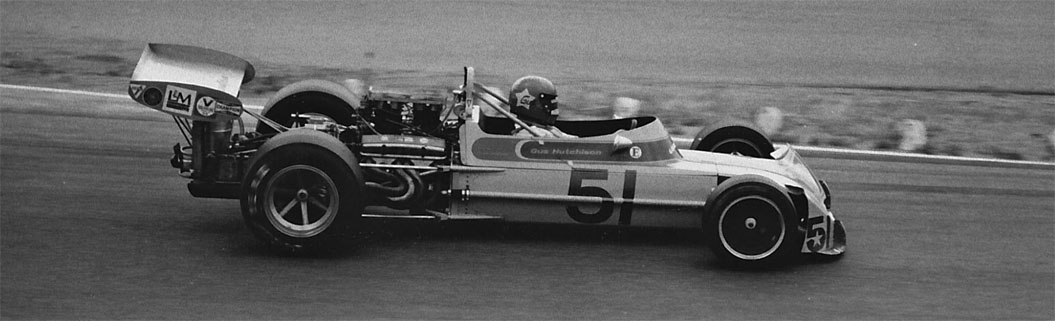
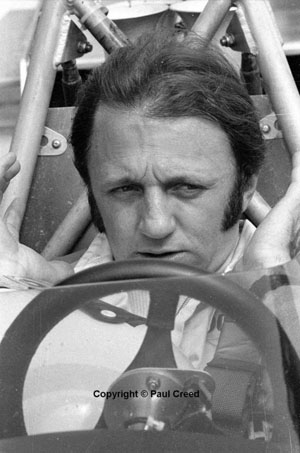
Name:Gus   Surname:Hutchison
Country:United States   Entries:1
Starts:1   Podiums:0
Fastest laps:0   Points:0
Start year:1970   End year:1970
Active years:1    

Gus Hutchison (born 26 April 1937 in Atlanta, Georgia) is a former racecar driver from the United States.

He was the winner of the 1967 SCCA Grand Prix Championship driving a Lotus 41.
In 1970, he purchased a Formula One Brabham BT26, entering it in the 1970 United States Grand Prix. He retired after 21 laps with a loose fuel tank.
When Formula A became Formula 5000, Hutchison continued driving in the SCCA series, driving cars from Lola and March. Info from Wiki


Bio by Stephen Latham

A regular SCCA competitor in the 1960s and early 70s, Augustus ‘Gus’ Hutchison won 1967’s Championship and raced a privately entered Brabham BT26 in the 1970 US Grand Prix. Born on the 26th April, 1937, in Atlanta, Georgia, besides his racing he showed an entrepreneurial streak. After graduating with a Bachelor of Science degree in chemistry from the University of Georgia, he moved to Dallas to embark on his professional career in the chemical field. In 1962 he founded his chemical manufacturing business Chemscope, a chemical manufacturing and services firm, which grew rapidly to over $1 million in annual turnover within five years and in 1967 he also formed Hutchison Racing Engines, to prepare twin-cam engines for the SCCA’s professional categories.

His early racing exploits started in 1958 with an MG and he quickly progressed through amateur and regional competitions on a limited budget; he camped at the circuits to save his meagre funds. He won his first race with an Elva Courier at Tuskegee in 1959 and a later move into Formula Junior with a Lotus 20 saw him take the 1964 South-Western Regional title. Due to the success of his business, funds allowed him to attempt racing more seriously though his efforts were hampered by limited access to advanced parts, high travel costs, and even having to self-fund through his business. In the following year he raced a Lotus 23 and won a SCCA Regional event at Lake Charles plus was second in a National race there on the same day. CDuring this time there were strong divisional performances in Formula B during 1966 while contesting SCCA events with a Merlyn, he was fourth at Green Valley and second at Seguin then later in the year he raced a Lotus 22 at Riverside and was eighth.

After acquiring a Lotus 41C-Ford twin cam, 1967 proved to be his year and he dominated the Formula A season, taking 36 points under the series’ scoring system that awarded 9 points for a win, 6 for second, and so on. Racing the yellow Lotus, he won the Colorado Grand Prix at Continental Divide Raceway, the Bridgehampton Continental Race, the War Bonnet Continental Race at Brainerd and the Lake Tahoe Continental Race. He retired from the St. Jovite Grand Prix at Mont-Tremblant after 15 laps due to mechanical issues and the race was won by Fred Ashplant in a Brabham BT21A, though Lou Sell and Mike Hiss (also in BT21As) provided the most consistent competition to Gus.

His success was helped by his team’s strategic setup, operating a three-car effort with Lotus 41Cs in the Southwest Division, including entries for teammates Joe Starkey and Harold Krech, which provided mechanical support and data sharing. During the year he founded Hutchison Racing Engines to prepare twin-cam engines for SCCA professional categories. The Lotus 41C itself was a sophisticated F2-derived monocoque chassis, weighing approximately 1,000 pounds and powered by a BRM-prepared Ford twin-cam engine delivering around 150 horsepower. It offered superior handling and reliability over the heavier, more powerful Formula A prototypes that struggled with reliability issues and this combination allowed Gus to outpace competitors in the underpowered but agile machinery.

There was a second-place finish at the Selma National in 1968 driving a newly acquired Brabham BT21A though regulatory changes led to him briefly leaving the sport. He returned in 1969 for the Formula A season finale at Sebring in late December and finished second with a privately entered Brabham BT26A. He mounted a full-season F5000 challenge in the SCCA L&M Continental Championship the following year with Champlin Racing’s Brabham BT26A, finishing second in the standings, behind champion John Cannon and ahead of third and four placed David Hobbs and Eppie Wietzes. John Cannon dominated the first race, with Gus eighth, and Cannon followed this with fourth at Edmonton and won again at Seattle. Ron Grable led from pole at the fifth round at Sears Point, but after his engine failed Gus took over and scored the first of two straight wins, with Dallas following. Cannon won at Road America and re-established his championship lead though George Follmer dominated at Mont Tremblant, ahead of Cannon. David Hobbs took the next two victories, at Brainerd (with Cannon second and Gus third) and Lime Rock, although Cannon’s regular podium placings had given him a strong championship lead. Mark Donohue won at Mosport (with Gus sixth) though Follmer took the win at the penultimate round at Mid-Ohio (with Cannon second and Gus fourth) and Donohue took victory at the final race at Sebring. In a switch to a Lola T190 Gus was third at Donnybrooke, sixth at Mosport and fourth at Mid-Ohio then made his F1 debut in October at the US GP at Watkins Glen with a Brabham BT26 (which lckx had used early in 1968). He and Peter Revson were the only two American starters and he qualified 22nd (out of 24 starters) with a lap time of 1:42.70 just 0.01 seconds quicker than Jo Siffert’s March-Ford. After starting from the back of the grid, he held a steady position among the midfield battles though on lap 22, a loose fuel tank caused fuel leakage and ended his race.

In the following years he competed in 1971’s Questor GP at Ontario with an Aero Structures Development’s ASD American Mk.1 though was not classified. There were also Formula B outings that year with a Techno TF70 at Seattle and Laguna Seca plus a Cicada 2 at Road America. 1972 started with two March 722 drives in a non-championship race at Bogota, retiring due to engine issues in the first then finishing seventh in the second race while in five F5000 races with a Hutchison Racing Engines Inc. Lola T300, his best results were fifth and fourth at Brainerd and Riverside. Continuing in F5000 with a Chevrolet powered Hutchison Racing Engines Inc. March 73A, his only finishes in 1973 were ninth at Riverside, fourth at Laguna Seca and fifteenth at Mid-Ohio. In two outings in October the following year with a privately entered 73A he was eighth and tenth at Laguna Seca and Riverside and, in his two final outings in October 1975 with a Lola T330, he retired at Laguna Seca and was sixteenth at Riverside.

After retiring from racing in 1975 he focused on new ventures, including founding Solar Kinetics, a manufacturer of professional lighting systems powered by solar energy where he was the director of development and chief engineer. The company evolved over the decades and was later known as KW/2 Prime Time Lighting but it was acquired by new owners in 2013 though Gus remained involved in product development.

Despite his achievements and contributions to American open-wheel racing through his engine-building venture Hutchison Racing Engines, he remains a relatively under-recognised talent in motorsport history, overshadowed by more prominent contemporaries. However, his story highlights the challenges faced by independent American racers (and other nationalities’ privateer racers) aspiring to global stages in the mid-20th century.

1974 Riverside USA F5000. Copyright unknown

Gallery   F1   F5000   Other


Other bios and info

error: Content is protected !!

This website uses cookies to give you the best experience. Agree by clicking the 'Accept' button.