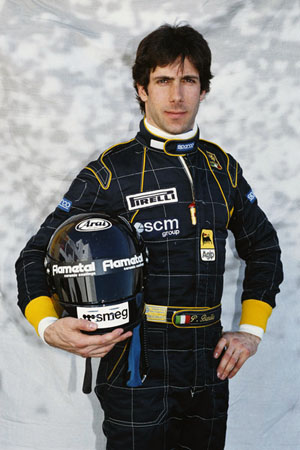
Paolo Barilla (born 20 April 1961 in Milan, Italy) is a former Formula One driver who raced for the Minardi team. He is one of the heirs of the vast Barilla pasta empire and, as of January 2017, had a net worth of US$1.39 billion. Info from Wiki
Bio by Stephen Latham
One of the heirs of the Barilla pasta empire, which had been founded in 1877 by his great-grandfather Pietro Barilla Sr, Paolo Barilla raced for Minardi between 1989 and 1990 though he achieved greater success in sports cars, winning Le Mans in 1985. He stopped racing at the end of 1991 and joined the family business, and is now the Deputy Chairman of the Barilla Group, which is the world’s largest pasta producer.
Born on the 20th April 1961, in Milan, Italy, Paolo started racing in 1975 and won the Italian 100cc karting title in 1976. He contested Formula Fiat Abarth in 1980 and a year later graduated into the Italian F3 Championship with a Martini-Alfa Romeo MK34. He was able to win two of the first four races, at Enna-Pergusa and Varano, and was second at Monza and Imola plus third and fourth at Monza and Varano but though he did not win again that year he was consistent enough to finish third in the series.
From there he moved into F2 in 1982 with the Minardi team, racing alongside Sandro Nannini, where his best results with the Minardi Fly 281B were seventh at the International Trophy at Silverstone and the B.A.R.C 200 at Thruxton plus eighth at Santa Monica. He continued to race in F2 in the following year plus contested a number of European and World Sportscar rounds. In 1000km events alongside Giorgio Francia with Scuderia Mirabella’s Lancia LC2, they finished sixth in the Spa 1000 km but suffered mechanical retirements at Imola, Mugello, Nurburgring and retired due to a spin at Brands Hatch. Making his Le Mans debut with Martini International Racing Team’s Lancia LC2-83, he, Alessandro Nannini and Jean-Claude Andruet retired after 135 laps (turbo).
Continuing with the Martini International Racing Team in 1984, now racing a Lancia LC2-84, the season started with third and fourth place finishes alongside Mauro Baldi in the Monza and Silverstone 1000 km events though, joined by Hans Heyer, they retired at Le Mans (camshaft, 275 laps). He and Alessandro Nannini were third in the Nurburgring 1000 km plus there was a second place finish in the Kyalami 1000 km with Bob Wollek, having started on pole.
1985 started with ninth in the Monza 1000 km with Hans Heyer and sixth in the Silverstone 1000 km alongside Klaus Ludwig and Paul Belmondo with the Joest Racing Team Porsche 956. Paolo also took convincing victories in two Interseries rounds at Most and Nurburgring plus was third in the Spa 1000 km with Klaus Ludwig, though he achieved his greatest result when he shared victory in the Le Mans 24 Hours in the Joest/New Man Porsche 956B. The works Porsche team were favourites and the Joest team returned with their winning 956B from the previous year, with Klaus Ludwig as lead-driver alongside Paolo and pay-driver Louis Krages (racing as ‘John Winter’). In qualifying, Hans-Joachim Stuck set a new lap record, with an average speed over 250 km/h, and took pole position with a lap record of 3:14.8 set on the first day of practice while Joest were fourth, with Ludwig over five seconds behind the leader (on 3:20.0). At the start, Wollek quickly surged into the lead from the second row of the grid, past the two works Porsches and the Lancia, followed by Ludwig. With tighter fuel regulations set by FISA, the teams had to be more mindful of fuel economy and speed but from the start the Joest and Richard Lloyd Racing teams had the measure of the field. After the first fuel-stops the Joest and RLR teams set the pace, with Larrauri’s Brun Porsche in close pursuit. Ludwig and Palmer had worked out together that they could slipstream each other, not racing, and alternating the lead between each other to minimise their fuel consumption. Around 9am, an accident brought out the pace cars for 30 minutes to repair the armco and Joest put John Winter in the driver’s seat. He put in a single seventy five minute stint before leaving the rest of the driving to his team-mates and at this stage the top dozen cars were still all within two laps of each other. Through the night, the Joest car continued to defy expectations, consistently doing an extra lap in every stint to the other teams. After 12 hours, they had covered 185 laps and were a lap ahead of the Rothmans Porsche while the Brun car of Larrauri/Sigala/Tarquini and Wollek/Nannini Lancia were several laps back. As dawn approached, the Joest Porsche was running well and Ludwig stated “it was quite easy really, although we were only driving at 99%. We were careful to conserve the engine and we tried to use the slipstream of other cars down the straight as much as possible. If we could get a good tow, then we were able to cut back the boost a little bit and make sure we kept plenty of fuel in hand.” The drivers were told not to use first gear and run as low revs as they could, changing gears as little as needed and after Ludwig pushed hard in the cool dawn air, the team now had a three lap lead over the works Porsche. In the morning, Palmer took over the RLR Porsche at 11am and immediately began putting in very fast laps, often 10 seconds a lap faster than the Joest car. Despite taking a lap back, Ludwig kept calm and, being three laps behind, the team ordered Palmer to ease off again and conserve the car for the finish. In the final few hours, there were a number of cars struggling to get to the end but the Joest Porsche took a comfortable victory, with Ludwig taking his third overall win, while this was Paolo’s third attempt after moving over from the Lancia works team. The RLR Porsche of Palmer/Weaver/Lloyd was second and the works Porsche of Bell/Stuck had got to third just before midday and held onto that to finish seven laps behind the winners. Although described by the media as an ‘economy run’, Paulo and Ludwig actually achieved better results than the previous years as they covered 190 km (115 miles) further than they did winning the previous year. They also recorded the second-fastest race speed ever at Le Mans, which was only exceeded by the winning Porsche 917K of Helmut Marko and Gijs van Lennep in 1971. Such was their performance and fuel economy, they also won the Index prize and still had 140 litres of fuel left over. The others teams were at a loss to match their success though Ludwig explained it as a combination of running very low downforce, a carefully-programmed engine-management computer and being able to moderate the turbo-boost while slipstreaming. Both teams also only drove their third, amateur, driver for just a single one-hour stint. Away from sports cars, he also tested for the Toleman team at Estoril during the year.
He continued racing sports cars in 1986 though the Daytona 24 Hours alongside Randy Lanier and Gianpiero Moretti ended due to electrical issues on Joest’s 962 after six laps and he, John Winter and Bob Wollek were fifth in the Daytona Finale 3 Hours. There was a retirement at Le Mans while 1000 km events with the Porsche 956 saw sixth at Silverstone (with George Follmer and John Morton), fourth and fifth at Spa (with Ludwig) and Brands Hatch (with Winter and Ludwig) plus victory at Fuji with Piercarlo Ghinzani. He did not qualify in a Grand Prix de Mans F3000 event with Sanremo Racing’s March 85B and in a single outing with Gaston Andrey Racing’s Alba AR6, he, Martino Finotto and Carlo Facetti finished tenth in the 500 km Charlotte. In IMSA rounds with Bayside Disposal Racing’s Porsche 962, he and Wollek won at Miami, were sixth at Sears Point, third at the Riverside 6 Hours and at Lime Rock plus fourth at the Mid-Ohio 500 km though they retired at the Sebring 12 Hours.
Racing Luciano Pavesi Team’s Ralt RT21/87 he was seventh at Pergusa and eighth at Pau and Imola. World Touring Car drives with an Alfa Corse Alfa Romeo 75 Turbo alongside Jacques Laffite saw ninth at Nurburgring, tenth at Brno and the Tourist Trophy at Silverstone plus twelfth in the Spa 24 Hours (joined by Jean-Louis Schlesser).
In his first drive in 1988, he retired Momo Corse’s March 86G from January’s Daytona 24 Hours while drives with Joest’s Porsche 962 saw second in the Sebring 12 Hours alongside John Winter and Frank Jelinski plus third in the Nurburgring 1000 km with Bob Wollek. Drives with Toyota Team Tom’s 88C brought seventh in the 500 km Fuji with Tiff Needell plus fifth alongside Stefan Johansson in the 500 km Suzuka, while teamed with Needell and Hitoshi Ogawa he was tenth in the 1000 km Fuji and fifth in the 1000 km Suzuka. In F3000, he retired in one outing with a CoBRa Motorsport March 88B at Jerez while drives with Spirit Racing’s Reynard 88D produced fourth in the Daily Mail Trophy at Brands Hatch. He had several outings with Jordan Grand Prix’s Reynard 88D and was seventh at Dijon-Prenois though retired at Le Mans and Zolder. While spectating at a sports car race at Suzuka, he bravely rescued Denmark’s Kris Nissen from a burning car. His Porsche had burst into flames, with him trapped inside, and although dressed in civilian clothes, Paolo bravely helped rescue him from the flames.
At the end of the year, he did a deal to be Minardi’s test driver for 1989 and the team had an extraordinary season, with Pierluigi Martini performing outstandingly in qualifying. In Portugal Martini lead a GP for one lap, the first and only time for a Minardi, but during the weekend he bruised one of his ribs when he fell from the stairs of the team’s truck. The injury got worse a week later at Jerez and Paulo then stood in for him and made his F1 debut at Suzuka. He did well to qualify, as thirteen cars did not make the grid, but unfortunately his clutch failed on him on the opening lap and Martini was back in the car for the next race, in Australia. All Japan F3000 drives with Nakajima Racing’s Lola T89/50 saw eighth at Suzuka, second at Mine and tenth at Suzuka while World Sportscar drives alongside Hitoshi Ogawa in Tom´s Racing’s Toyota 89C-V saw sixth in the Suzuka 480 km, third in the 500 mile Fuji and victory in the 1000 km Fuji. In Japanese Touring Car outings with a Bijo Toyota Supra Turbo, his best result was fourth at Suzuka with Takuya Kurosawa.
He was signed by Minardi for 1990 and with Luis Pérez-Sala having left the team, they lost Lois as the main sponsor and it was replaced by Italian woodworking company SCM Group. The Minardis were reasonably competitive during the first races but their performance deteriorated as the season progressed plus it was said that, being tall, Paolo did not fit well into the tiny cockpit of the car. The team used their M189 for the first two races of the season and Phoenix saw a Minardi on the front starting row, with Paolo fourteenth, but after a poor start, Martini faded and eventually finished seventh while Paolo retired then did not finish in Brazil. The M190 debuted at San Marino but Martini did not start the race after an accident in practice while Paolo qualified twenty sixth and went on to finish eleventh, which would be his best finish of the year. Gearbox issues ended his Monaco run and he did not qualify Canada then was fourteenth in Mexico. He failed to qualify in France then was twelfth in Great Britain, did not qualify in Germany and was fifteenth in Hungary. He retired from the Belgian GP due to an accident but did not qualify in Italy, Portugal and Spain and was then replaced by Gianni Morbidelli for the last two races of the year. Unfortunately the M190 did not score any points for the team in the Constructors’ Championship, with its best result Martini’s eighth place in Japan.
He continued racing sports cars sporadically until 1997 and also competed in the Paris-Dakar Rally and became involved with the family’s Barilla Corporation. In 2014 he won the Historic GP of Monaco in the F3 class plus drove a 1981 Williams FW07C at the 2016 FIA Masters Historic F1 Championship at Barcelona. He also owns a Ferrari 312B and in 2017 commissioned a documentary, ‘Ferrari 312B: Where the Revolution Begins’, detailing its restoration; there’s a great youtube video about this at https://youtu.be/61fkLQBIu6s
In 1991, he began his career in the family Company at Barilla France, a subsidiary of the Group then in 1994 was appointed Deputy Chairman of the Barilla Group, a role he still holds today. Starting from 2010 he was appointed Chairman of the newly formed Italian Association of Confectionery and Pasta Industries (AIDEPI) and in 2014, he became Deputy Chairman of the Barilla Center for Food & Nutrition Foundation, now the Barilla Foundation. In October 2016, he was elected Chairman of the International Pasta Organization (IPO) and from March 2017 to December 2018, he was the Chairman of the Italian Food Association (Unione Italiana Food), and from January 2019 to June 2023, he has taken on the role of Deputy Vice-Chairman. In June 2023 he was reappointed Chairman of the Italian Food Association (Unione Italiana Food). In 2025 the company became an Official Partner of Formula 1, with trackside signage, digital activations and consumer promotions featuring the Barilla branding.